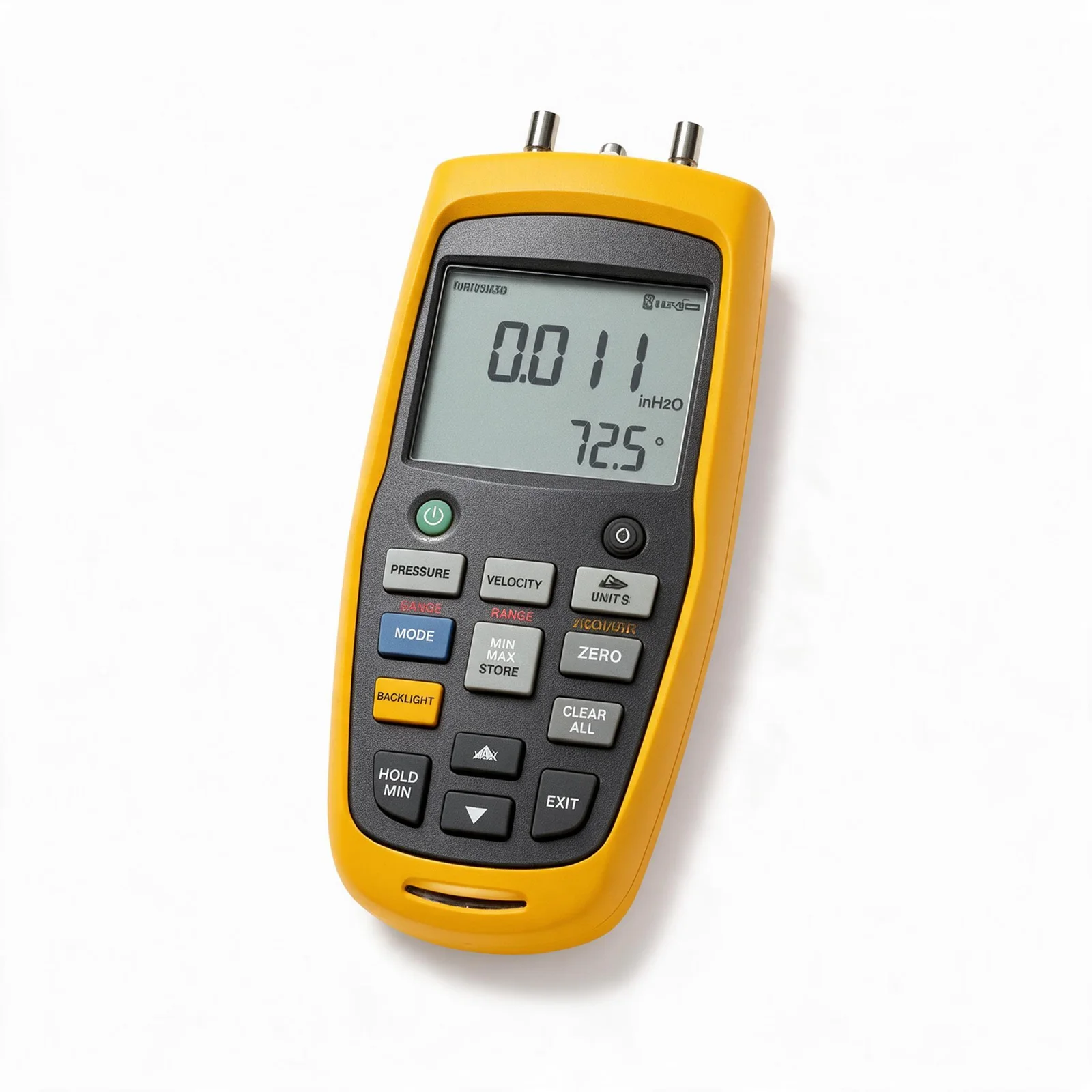
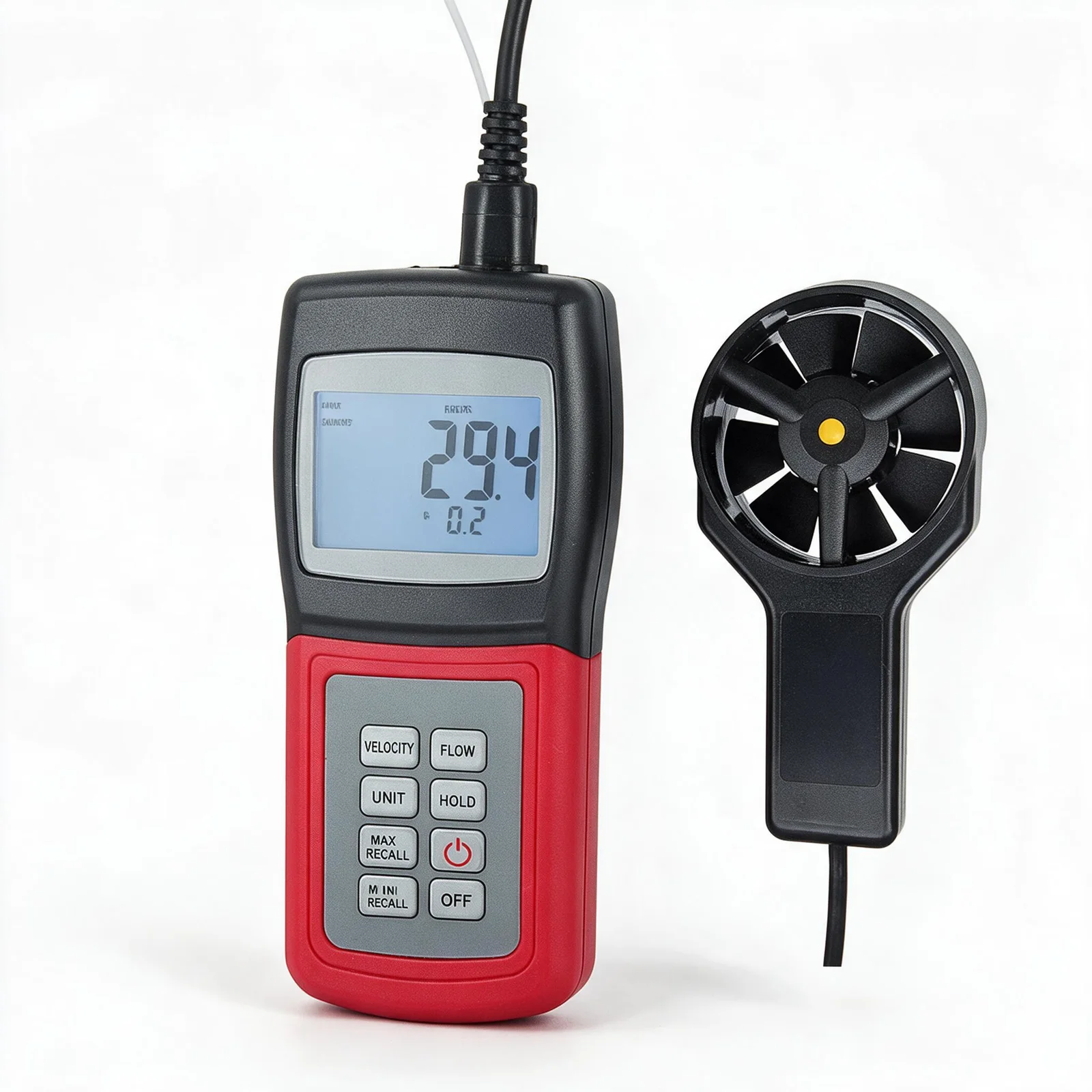
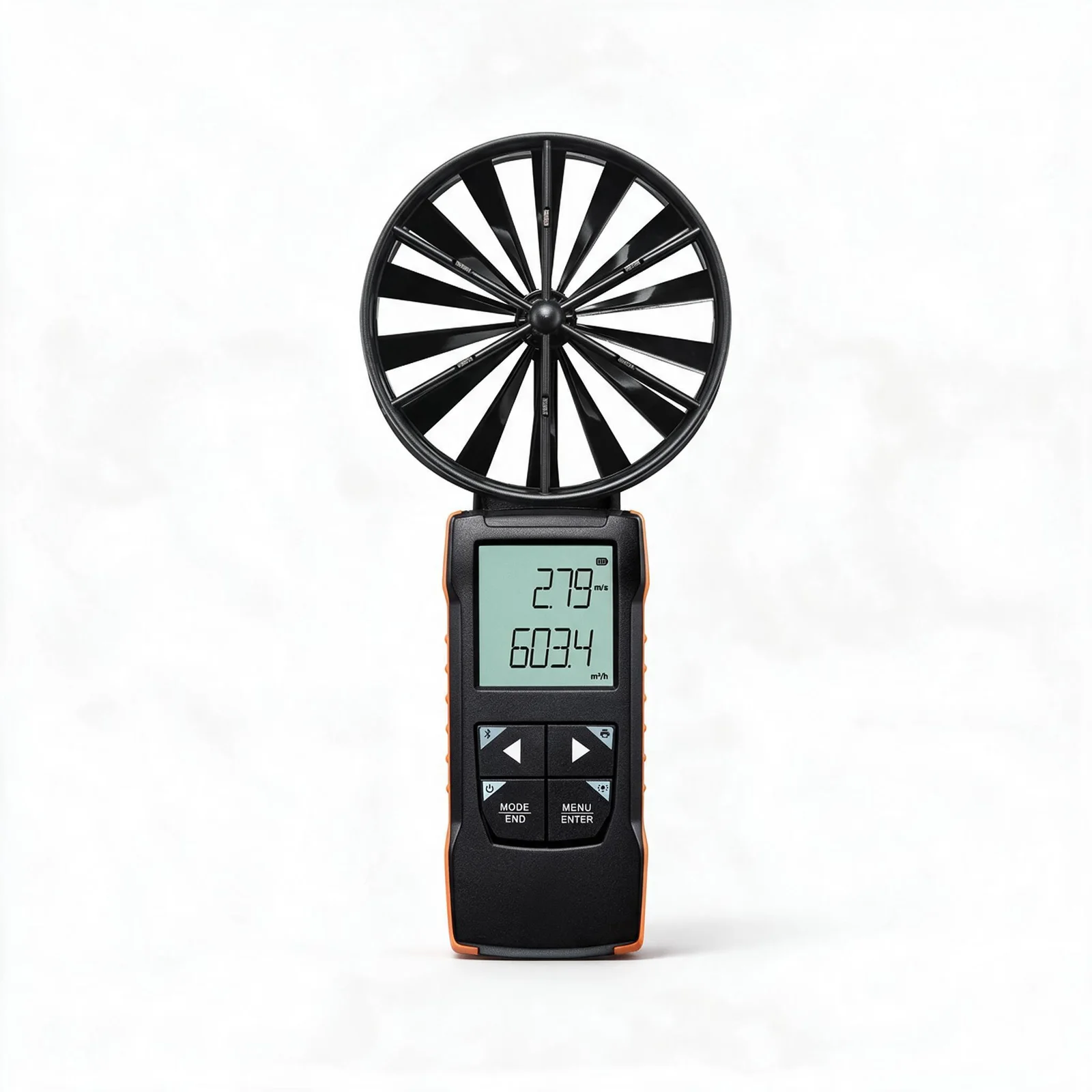
Illustrative image. Exact appearance, accessories, finish and markings must be confirmed against the quoted model.
Airflow InstrumentsFAMILY / AIR-002
Fluke 922 Airflow Meter / Micromanometer
Handheld airflow, differential-pressure and temperature meter for ventilation commissioning and maintenance.
Source-listed reference data
Model, technical values and commercial references below come from the supplied supplier sources captured for intake. Manufacturer sourcing, configuration, certification, stock, MOQ, price and lead time are confirmed before an order.
Single-product and multi-line requests use the same human-reviewed workflow.
01
Product overview
What this sourcing family is designed to organize.
The Fluke 922 measures air velocity and airflow with a pitot tube, differential pressure through two pressure ports, and temperature. It is suited to balancing and troubleshooting HVAC systems where velocity, duct area and pressure must be reviewed together.
Airflow Measurement
02
Reference configurations
Intake categories from the linked source, pending exact model and SKU mapping.
01Fluke 922Source reviewed
03
Technical specifications
Source-listed values are shown as intake references and remain subject to configuration and supplier confirmation.
Attribute
Catalog value
Verification basis
Accuracy
Air velocity ±2.5% of reading; pressure ±1% + 1 Pa; temperature ±1% + 2°C
Source-listed — supplier confirmation required
Data / output
LCD readings; no wired digital data output is stated in the reviewed specification
Source-listed — supplier confirmation required
Housing / ingress protection
IP40
Source-listed — supplier confirmation required
Measurement method
Two pressure ports for a pitot tube and tubing
Source-listed — supplier confirmation required
Measurement range
Air velocity 1–80 m/s; airflow up to 99,999 cfm / m³/h / l/s; pressure ±4,000 Pa; temperature 0–50°C
01When is the Fluke 922 a better shortlist candidate than a vane meter?
Consider the Fluke 922 when the approved method needs a pitot-tube velocity or airflow measurement, a duct traverse or differential pressure through two pressure ports. A vane meter may be more direct at an open grille. Select the instrument from the measurement location and report requirement, then confirm the pitot, hoses, pressure range, probe access, calculation method and calibration statement.
02What duct information is needed for a repeatable airflow measurement?
Provide duct dimensions, material, orientation, nearby bends or dampers, available straight run, access-port size and insertion depth. For a traverse, identify the measurement plane and number of points and use the project-approved method. A disturbed flow profile can invalidate an otherwise accurate instrument reading.
03How should probe type and physical access be checked together?
Confirm the probe head or insertion length, required orientation, opening size, cable reach and safe working position before comparing instrument accuracy. A probe that cannot cover the measurement area or reach the traverse plane cannot produce a representative result merely because its catalogue range appears suitable.
04What should be recorded with the final airflow result?
Record the instrument and probe, calibration status, ambient temperature and pressure, unit conversions, averaging or traverse method, raw readings where practical and the uncertainty statement. This makes commissioning results reproducible and separates instrument accuracy from installation and flow-profile effects.